Summary of 6 modes of STML MCU
10 Oct 2020 - John Z. Li
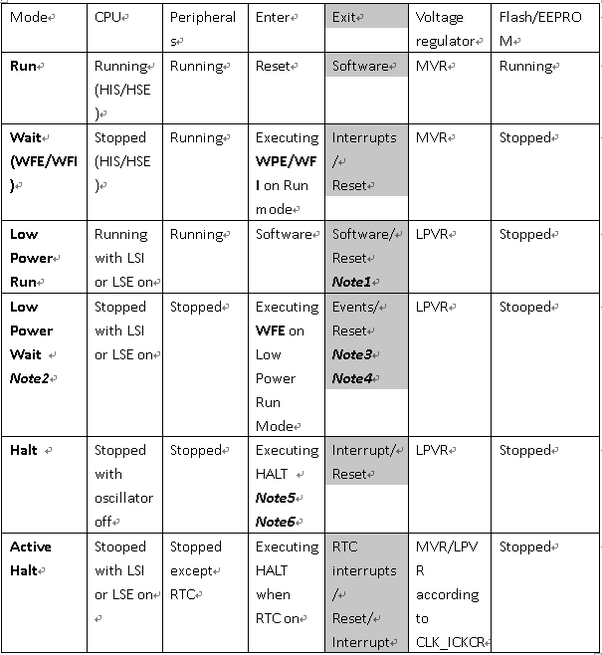
With the following 6 modes of MCU of STML series, below is a summary.
 Note:
Note:
Note1: All interrupts must be masked while exiting from Low Power Run mode. Interrupts must not be used to exit this mode.
Note2: While in Low Power Wait Mode, all interrupts must be masked. They must not be used to exit from this mode.
Note3: When woke up from Low Power Wait Mode by an event, the MCU transits to Low Power Run Mode.
Note4: In Low Power Wait Mode, some interrupts are served if it has been previously enabled. After processing the interrupts, the processor goes back to Low Power Wait Mode.
Note5: Before executing HALT, any pending peripheral interrupt must be cleared by clearing certain bit in corresponding registers. Otherwise, HALT will fail to be executed. HALT can also be delayed because some flags of certain register are set.
Note6: It is not safe to execute HALT from the Low Power Run Mode.
Notation:
WFE: Wait for Event
WFI: Wait for Interrupt
MVR: Main Voltage Regulator mode
LPVR: Low-Power Voltage Regulator mode
RTC: Real-Time Clock
HSE: High Speed External crystal
HSI: High Speed Internal oscillator
LSE: Low Speed External crystal
LSI: Low Speed Internal oscillator
How can Reset occur:
-
External reset via the NRST pin
-
POR (Power-On Reset)
-
PDR (Power-Down Reset)
-
IWDG (Independent Watchdog) reset
-
WWDG (Window Watchdog) reset
-
ILLOP (Illegal Opcode) reset
-
SWIM reset